
FIFA Secretary-General Mattias Grafstrom expressed confidence in Iran's participation in the upcoming World Cup after a meeting with Iran's FA President Mehdi Taj, despite concerns over visa issues and political tensions.

US Secretary of State Marco Rubio stated that significant progress has been made in negotiations with Iran to reopen the Strait of Hormuz, a critical global shipping lane. However, President Donald Trump remains cautious, vowing not to accept a 'bad deal' regarding Iran's nuclear programme and regional stability.

Iran has announced the Strait of Hormuz is open to commercial vessels, coinciding with a ceasefire between Lebanon and Israel.

The United States Central Command (CENTCOM) has announced that American forces are maintaining a strict maritime restrictive operation in the region, continuing to enforce a blockade against Iranian ports.
China has called on Iran to reopen the Strait of Hormuz and expressed appreciation for Tehran's commitment not to develop nuclear weapons, a key demand of the US to end the conflict.

Iran has lodged a formal complaint with the United Nations, accusing the US of engaging in 'piracy' following the seizure of Iranian vessels. The complaint was detailed in a letter sent by Iran's UN envoy to the UN Secretary-General and the Security Council.

Iran has asserted that maritime movement through the Strait of Hormuz will be strictly controlled by Tehran, stating that passage will be allowed only through designated routes and under Iranian approval.
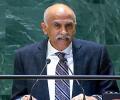
India has strongly condemned an attack on UN peacekeepers in Lebanon that resulted in the death of a Serbian Blue Helmet and injuries to two others. The nation has called for an immediate and thorough investigation to ensure accountability for the perpetrators. This incident follows a series of attacks on UNIFIL personnel amidst escalating hostilities in the region, prompting global calls for peacekeeper safety.

In a development that could reshape West Asia's security landscape, US President Donald Trump announced Friday that he will convene an emergency meeting in the White House Situation Room to make a final decision on a broad, multi-part peace deal with Iran.

Amidst escalating tensions in West Asia, Russian President Vladimir Putin is actively calling for de-escalation and political resolution, engaging with Iranian and US counterparts to navigate the complex conflict landscape.

Iraq's Kurdistan Regional Government (KRG) on Saturday confirmed a drone strike targeting the residence of Kurdistan Region President Nechirvan Barzani in Duhok amid escalating tensions in West Asia, triggering a sharp blame game between the United States and Iran.

In a significant diplomatic manoeuvre aimed at de-escalating regional tensions, Iran has reportedly submitted a "new proposal" to the United States through Pakistani intermediaries.

Donald Trump has dismissed the ceasefire with Iran as being on 'massive life support', signalling continued tensions between the US and Iran amid ongoing negotiations.

Tensions escalate between Iran and the US following an attack on an Iranian commercial vessel in the Sea of Oman, with both sides trading accusations over maritime security and ceasefire violations.

Pakistan's Foreign Office has refuted media reports suggesting that its efforts to facilitate peace talks between the US and Iran have stalled, calling the reports baseless and speculative.

Iranian President Mahmoud Ahmadinejad will undertake his first-ever visit to India next week on his way to Sri Lanka. Ahmadinejad's visit comes at a time when Iran is facing United Nations sanctions and isolation from several countries. NSA M K Narayanan pitched for better treatment of Iran internationally, saying it was an ancient civilisation, and a major country with tremendous influence.

The US-China rapprochement, however tenuous, is not without implications for India. Both China and Pakistan have become closer to the US, notes Ambassador T P Sreenivasan.

The United States and Iran could resume negotiations as early as next week in Islamabad, according to a report by The Wall Street Journal citing people familiar with the matter.

US President Donald Trump is inclined to reject Iran's latest diplomatic proposal, which suggests restoring maritime traffic through the Strait of Hormuz while deferring nuclear programme concerns, according to CNN. Concerns remain over Iran's nuclear enrichment and internal government fractures.

Protests on multiple fronts disrupted the atmosphere outside the FIFA Congress in Vancouver on Thursday, as demonstrators raised sharply different concerns over global politics and local issues.

In a lengthy post on Truth Social, Trump said negotiations with Iran were 'proceeding nicely' and argued that several Muslim and Arab nations should formally recognise Israel and join the Abraham Accords once a deal is reached.

US President Donald Trump on Tuesday claimed that Iran is in a "state of collapse" and has requested the United States to help "open" the Strait of Hormuz.

US President Donald Trump received a red carpet welcome in Beijing for talks with Chinese President Xi Jinping on trade, the Iran war, and other key issues. The visit underscores the importance both nations place on their relationship amid ongoing tensions.
US President Donald Trump is reportedly considering launching fresh strikes against Iran if ongoing negotiations fail to produce a peace deal, according to US media outlet Axios. This development comes as diplomatic efforts continue, with Pakistan and Qatar attempting to broker an agreement.

Pakistan's Prime Minister Shehbaz Sharif has offered to host talks between the US and Iran to help resolve the ongoing conflict in the Middle East, following reports of Pakistan's involvement in backchannel diplomacy.
Iran has submitted a fresh proposal to regional intermediaries offering to cease its military operations in the Strait of Hormuz, contingent upon a complete cessation of hostilities and the removal of the US blockade on Iranian maritime hubs.

US President Donald Trump has claimed that China has committed to halting weapon supplies to Iran, following his personal diplomatic interventions with Chinese President Xi Jinping.

US President Donald Trump and Chinese President Xi Jinping met in Beijing to discuss a range of issues, including trade frictions and the war in Iran.
Direct talks between the US and Iran, mediated by Pakistan, have failed to produce an agreement after 21 hours of negotiations, with disagreements over Iran's nuclear ambitions and sanctions proving insurmountable.

Khamenei urged the pilgrims for unity and called on them to pray for "the liberation of Palestine and Al-Aqsa Mosque, the alleviation of the great hardships afflicting Muslims, and the attainment of ultimate victory against global arrogance."
Amid ongoing tensions with the US, Iran's IRGC Navy has issued new directives restricting maritime movement through the Strait of Hormuz, allowing only civilian vessels on Iranian-designated routes and barring all military ships.

US President Donald Trump will visit China from May 13 to 15 at the invitation of President Xi Jinping. The visit occurs amidst global tensions, including the war in West Asia and trade disputes between the US and China. Discussions are expected to cover China-US relations, world peace, and economic issues.

High-level peace talks between the US and Iran, facilitated by Pakistan, aim to de-escalate the conflict in West Asia and potentially reshape regional stability.

Doubts are emerging about Pakistan's role in mediating peace negotiations between the US and Iran, with suggestions that Islamabad's efforts are stalling and failing to secure a definitive response from the United States.

Pakistan's Chief of Defence Forces Field Marshal Asim Munir held talks with Iranian leaders in Tehran to help resolve the conflict between the US and Iran, following a recent ceasefire agreement.

US President Donald Trump is set to visit China for talks with President Xi Jinping on trade, global issues, and the Gulf war. The visit aims to address trade frictions and other key issues, with high expectations for progress.

US President Donald Trump has indefinitely extended the ceasefire with Iran at the request of Pakistan, aiming to allow Tehran's leadership time to form a unified proposal to end the seven-week war.

Iran has denied sending a delegation to Islamabad for peace talks with the United States, contradicting Pakistan's claims of mediating the negotiations. The denial highlights a lack of confidence in Pakistan's ability to ensure security for high-level participants and underscores the fragile nature of diplomatic efforts between the US and Iran.

US President Donald Trump in an exclusive interview to Axios on Wednesday, said that he would continue to keep the naval blockade until Iran agrees to deal with the United States by addressing America's concerns about the nuclear programme.

Iran's Foreign Ministry has denied reports of planned talks with the United States during a visit to Islamabad, Pakistan, despite US envoys also visiting the region.
